


Today’s species is one that I’ve only seen once, though this particular animal troubled me for many years.
I spent my high school years in mid Wales where my family owned a holiday park of static caravans and visiting tourers. One of its big draws for both holiday-makers and myself was the fact this holiday park sat on the banks of the River Severn. The boundaries of our stretch were marked by the shallow and rocky rapids upstream and a road bridge downstream. Here, there were deep channels by either bank while the centre was not much more than ankle deep. In between these boundaries, one natural, one man-made, the slow-moving and relatively shallow water was punctuated with deeper pools where the river bed remained out of reach and all sorts of unknown creatures lived.
This stretch between the rapids and the bridge was my playground. Here I caught minnow in a small net, found frogs, watched kingfishers and herons and in summer I swam and kayaked. A sturdy rope swing, there when I arrived and probably still there when my family sold up, flung people from the bank into the deepest pool. In the summer months we built rope crossings and held duck races and raft races. It was in my first summer at the holiday park that I first ventured into the water (not counting the occasion I fell in one cold, early spring day). In that same week, I learnt about the eels.
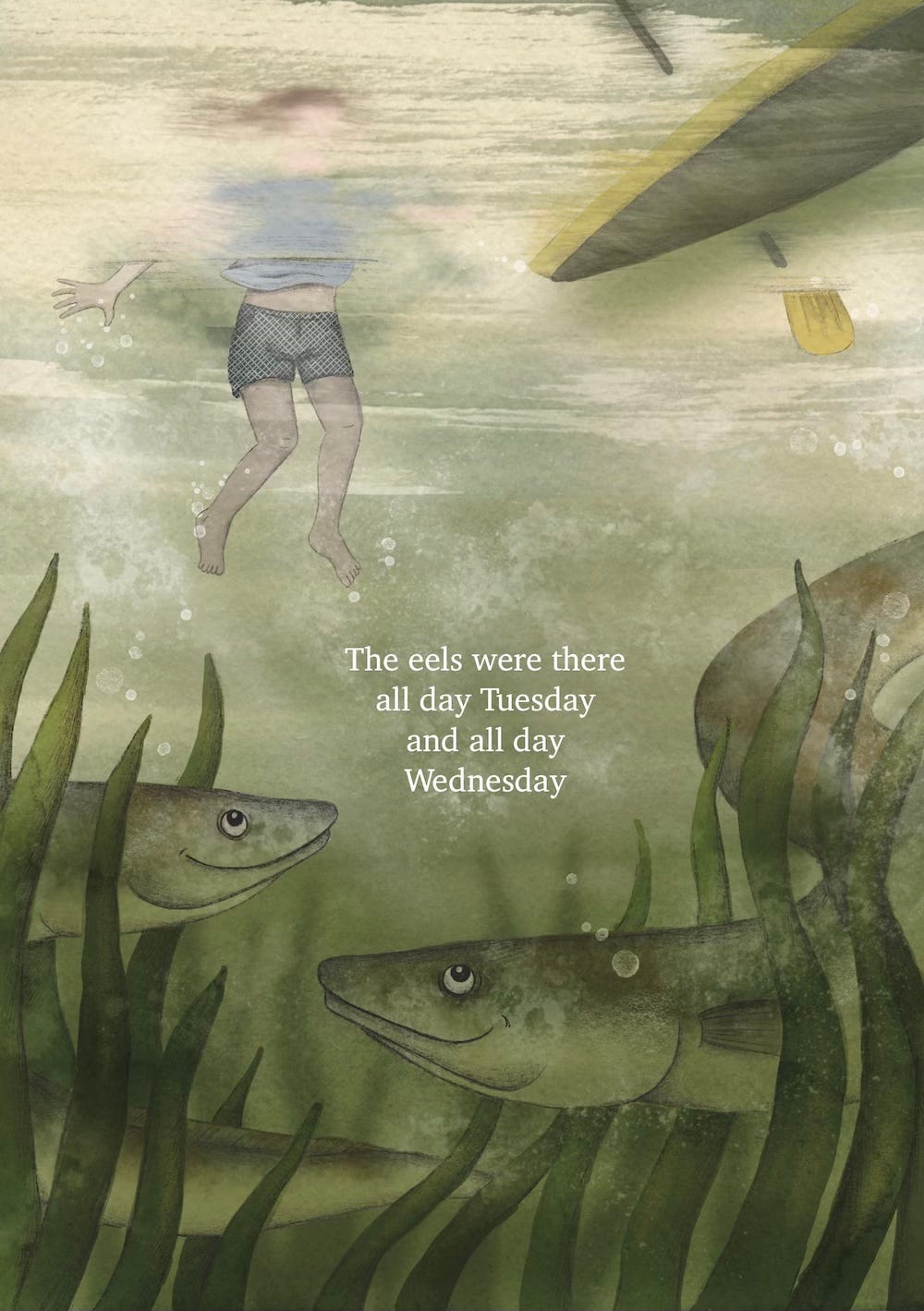
I’d seen plenty of fish in the clear waters before this, including huge pike. None of them particularly bothered me, but when I found out from an angler there were eels in the river, I was troubled. Eels are a different animal altogether. More snake-like than fish. Slimy and unpleasant and surprisingly big. I didn’t want to go back in the water, and yet, like some 90s proto-Moana, the water called me.
I clearly remember a conversation with my mum where I agonised over the presence of the eels. My mum, with a busy holiday park to run and little patience for my foibles said “Well you were in the river all day Tuesday and all day Wednesday and the eels were there then.”
“You mean they will have gone by now?” I asked hopefully.
The correct answer here would have been a simple yes. My mum looked at me like I was an idiot. I was an idiot. “No. I mean they didn’t bother you then so why would they bother you today?”
She could have just said yes. She was right, of course. In all the days I spent in the Severn over the years, I never once saw an eel. I never so much as felt the sinuous slip of an eel against my foot. And yet they continued to trouble me.
My English teacher at the time told us in some detail how to skin freshly-caught eels. That troubled me. (He also taught us the correct way to hold a goose and in case you were bitten by an adder, the local hospital didn’t hold the anti-venom.) What troubled me most though was the eel’s ability to trap water in its gills allowing it to leave the water and travel across land. In reality this impressive feat for a fish* enables them to move across wet ground to navigate obstacles or move to more favourable environments. But in my mind, eels were leaving the river en masse every night, scaling the 5 foot river bank and rampaging through the caravan park. I was terrified of finding one in the grass and even more terrified of finding one curled around the foot rest of my kayak. And while my favourite place to be during those years was in or near the Severn, eels were never far from my thoughts.
In fact it wasn’t until I was in the final year of my undergraduate degree that I saw an eel and it wasn’t in the river, or the grass, or even the bottom of my kayak. It was on a beach in Wales being chased—and caught—by a group of excited young men on my marine biology field trip. The eel was held just long enough to be admired by the group before being released to the shallow, trickling channel of sea water where he’d first been spotted. While we tend to think of eels as a freshwater fish, they are in fact so much more remarkable than that.
So remarkable that it wasn’t even understood where eels came from until relatively recently. Even the very reproduction of eels was a mystery for millennia. Aristotle believed they spontaneously appeared from the ‘entrails of the earth’. It was only at the end of the 18th century that someone confirmed eels do, in fact, have reproductive organs. It was the end of the 18th century before scientists confirmed the larval glass eels and the familiar yellow eels were in fact the same species in different life stages. At the beginning of the 20th century, one scientist traced the earliest larval forms to the Sargasso Sea, in the North Atlantic. Though no eggs nor adult eels were found there. It would be another hundred years before, in 2022, mature eels were tracked to this location and it was proved to be the spawning ground of the European eel. Think about that, a species that has been fished for centuries across Europe, that were once a common part of the average Brit’s diet, and it was only four years ago that we could say with complete certainty where they came from.
Adult eels make a journey of up to 10,000km to their spawning ground where they die. From here, the tiny larvae, carried by the Gulf Stream, take several years to reach the shores of Europe in which time they have transformed into the small, translucent glass eels once thought to be a different species. At this point, the fish’s physiology transforms from one built for a marine environment to one of freshwater. The glass eel travels upstream where it transitions into an elver, or young eel, before reaching the stage known as a yellow eel—the form which rampages across caravan parks and hides in kayaks. At some point they grow bored of this rampaging and return to the sea. Only when they reach the coast do they reach their full sexual maturity, which perhaps explains why scientists took so long to find their reproductive organs.
In the time since I swam amongst the eels, the species has suffered a catastrophic 95% decline in numbers, putting it on the critically endangered list. That’s an astonishing figure that will impact the wider river ecosystems as eels, in their various life stages, provide vital food for birds, fish and mammals such as otters. And yet, people continue to eat eels. It’s perfectly legal to fish for eels in the UK, with a rod licence.
I can’t say the eel I saw on the beach was beautiful, but knowing what I do now about their life-cycle I have a new-found respect, if not quite love, for this fish. There’s a shop on Liverpool’s Albert Dock that stocks my artwork. Last year, the shop’s owner posted an amazing video on Instagram of an eel glistening as it swam near the surface of the water outside the shop. Now whenever I find myself by the docks, I scan the water hoping to catch a glimpse of this once troubling species.
*I made myself laugh here at the suggestion of fish feet. So easily amused is my mind.
I had forgotten that eels could cross land. They are amazing creatures. It's a pity they aren't given more attention.
I learned a lot about eel from your post, Dani! I didn’t know that they are endangered! In Japan, eel is very coveted. My mom’s favorite dish is grilled eel. I wonder why there are no restrictions for fishing for eel though. I look forward to reading more of your posts about animals!